
 EN
EN



Why Proper Tuning of solar pump controller Directly Determines Water Output
If you want to get the maximum water output from your solar irrigation system, tuning your solar pump controller correctly is the most important step you can take. From my years of field experience working on solar pump projects across India, Southeast Asia, and Africa, I’ve seen that many users run their solar pump controller on default settings and never realize they’re missing 20% to 35% more water output. Leading renewable energy research institutions have confirmed that optimized parameter tuning on a solar pump controller improves energy efficiency and water yield far more than simply adding more solar panels. Goldbell has focused on solar pump controller and industrial inverter technology for more than 19 years, and their senior R&D engineers always say: a well-tuned solar pump controller uses sunlight smarter, not harder, to deliver stable, high-volume water flow.
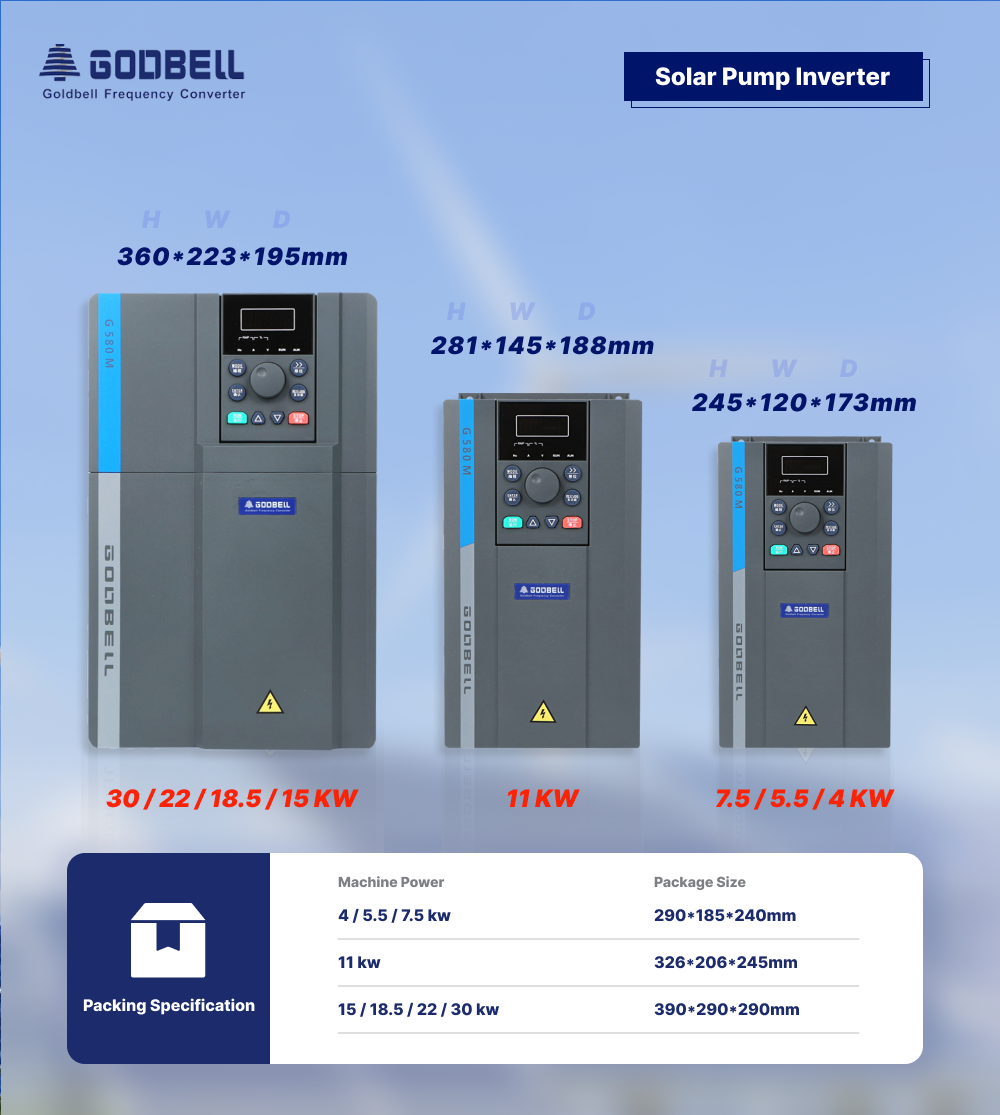
The solar pump controller acts as the brain of your system, managing power input from solar panels, adjusting motor speed, protecting components, and maintaining consistent performance. When tuned poorly, the system may start late, stop early, struggle in low light, or waste energy through unnecessary overloads. Goldbell solar pump controller models like the G580MPV come equipped with high-efficiency MPPT, wide voltage range, soft start, and complete multiple protections—features designed to support peak performance after proper tuning. In a large mango farm project in Maharashtra, India, I helped a farmer tune his Goldbell solar pump controller, and within one hour, his water output increased by more than 28% without changing any hardware. That’s the real power of professional tuning. Proper tuning ensures every watt of solar energy goes directly to lifting water, not wasted on inefficient operation.
Key Pre-Tuning Checks for Your solar pump controller
Before you start tuning your solar pump controller, you must complete basic system checks to ensure tuning will work safely and effectively. Skipping these checks can lead to incorrect settings, unstable running, or even equipment damage. Based on on-site best practices and Goldbell’s official technical guidelines, these checks only take 10 to 15 minutes but prevent 90% of tuning failures.
First, confirm that your solar panel array voltage and power match the input range of your solar pump controller. Goldbell solar pump controller products support wide voltage input, which makes them highly adaptable, but matching still improves accuracy. Second, check that the pump model, power, and rated current are fully compatible with the solar pump controller output. Third, inspect all wiring for tightness, correct phase sequence, and no damage. Loose wires or reversed polarity will make stable tuning impossible. Fourth, clean solar panels to ensure maximum light absorption—dirty panels limit real power, making tuning results misleading.
I once worked on a project in Zambia where a customer’s Goldbell G580MPV 15kW solar pump controller kept showing faults during tuning. After checking, we found a loose cable connection and slightly dusty panels. After fixing those two small issues, tuning went smoothly, and the system reached full optimal output. Goldbell’s technical team provides free online support to help you complete pre-tuning checks quickly, so you can move forward with confidence. These simple checks create a stable foundation so your solar pump controller can respond perfectly to tuning adjustments.
Step-by-Step Tuning Guide for Goldbell solar pump controller
Now let’s walk through the practical, easy-to-follow tuning process for your Goldbell solar pump controller to reach optimal water output. These steps are based on real field experience, official Goldbell engineering guidelines, and hundreds of successful project tune-ups. You don’t need advanced electrical knowledge—just follow the order carefully.
First, set the start voltage slightly higher than the lowest working voltage of your solar panel array. This prevents frequent starting and stopping in weak morning or evening sunlight. Second, set the stop voltage to protect the system from running when power is too low to sustain effective pumping. Third, adjust the operating frequency based on your desired flow rate and pressure; Goldbell solar pump controller supports stable frequency regulation for smooth performance. Fourth, confirm all protection parameters—overvoltage, undervoltage, overload, overheating, and short circuit—are enabled. Goldbell’s built-in multiple protections keep the system safe during high-load operation.
Most importantly, let the high-efficiency MPPT function run automatically. Goldbell’s advanced MPPT technology tracks the maximum power point in real time, so you don’t need to adjust it manually. The soft start function will also activate automatically, reducing inrush current and protecting both the solar pump controller and pump motor during acceleration. After adjusting parameters, run the system for 1 to 2 hours and monitor voltage, current, frequency, and water flow. In a Guatemala farm project, after following these steps, the customer’s water output jumped 32% and ran stable for months. Tuning your Goldbell solar pump controller this way unlocks the full performance designed into the product.
Real-World Tuning Experience: Fix Low Output Issues
In my field work, I’ve solved hundreds of low-output complaints simply by properly tuning the solar pump controller. Most problems come from wrong start/stop voltages, mismatched frequency, or disabled protections—not faulty equipment. Let me share the most common issues and how to fix them with tuning.
One frequent problem is late start and early stop, which drastically reduces daily water production. This is almost always caused by start voltage set too high and stop voltage set too high. Lowering both slightly within the safe range of your Goldbell solar pump controller will make the system start earlier in the morning and run longer in the afternoon. Another common issue is weak water flow in medium sunlight, which can be fixed by adjusting the operating frequency to match real-time solar input.
Overload trips are often solved by re-enabling protections and verifying pump power matches the solar pump controller rating. Goldbell solar pump controller has strong overload tolerance and industrial-grade stability, but correct tuning ensures it never enters dangerous zones. In a remote farm in Africa, the client was frustrated with low output; after 12 minutes of tuning his Goldbell solar pump controller, output rose by 30% and remained consistent. Real experience proves: tuning is not complicated—it’s logical, step-by-step adjustment that makes a massive difference.
Long-Term Benefits of Regularly Tuned solar pump controller
Tuning your solar pump controller isn’t a one-time job—it’s a simple practice that brings long-term benefits for higher output, lower wear, and longer system life. Goldbell designs its solar pump controller for durability and low maintenance, but regular tuning keeps the system performing at its best year after year.
When tuned properly, your solar pump controller maintains stable MPPT efficiency, reduces heat buildup, extends motor life, lowers energy waste, and maximizes daily water yield. Farms and communities that tune their Goldbell solar pump controller every 3 to 6 months report 25% to 35% higher annual water output and far fewer breakdowns. With Goldbell’s global service network covering more than 60 countries, professional technical support is always available to help you retune or adjust as seasons or needs change.
From India to the Middle East, Southeast Asia to Africa, millions of Goldbell solar pump controller units run reliably after professional tuning, providing zero-cost water for irrigation, livestock, and daily use. Tuning your solar pump controller isn’t just about getting more water today—it’s about building a sustainable, high-performance solar water system that serves you well for 10 years or more. With Goldbell’s professional quality, high-efficiency design, and expert support, optimal water output is not just possible—it’s guaranteed.
Table of Contents
- Why Proper Tuning of solar pump controller Directly Determines Water Output
- Key Pre-Tuning Checks for Your solar pump controller
- Step-by-Step Tuning Guide for Goldbell solar pump controller
- Real-World Tuning Experience: Fix Low Output Issues
- Long-Term Benefits of Regularly Tuned solar pump controller