
 EN
EN



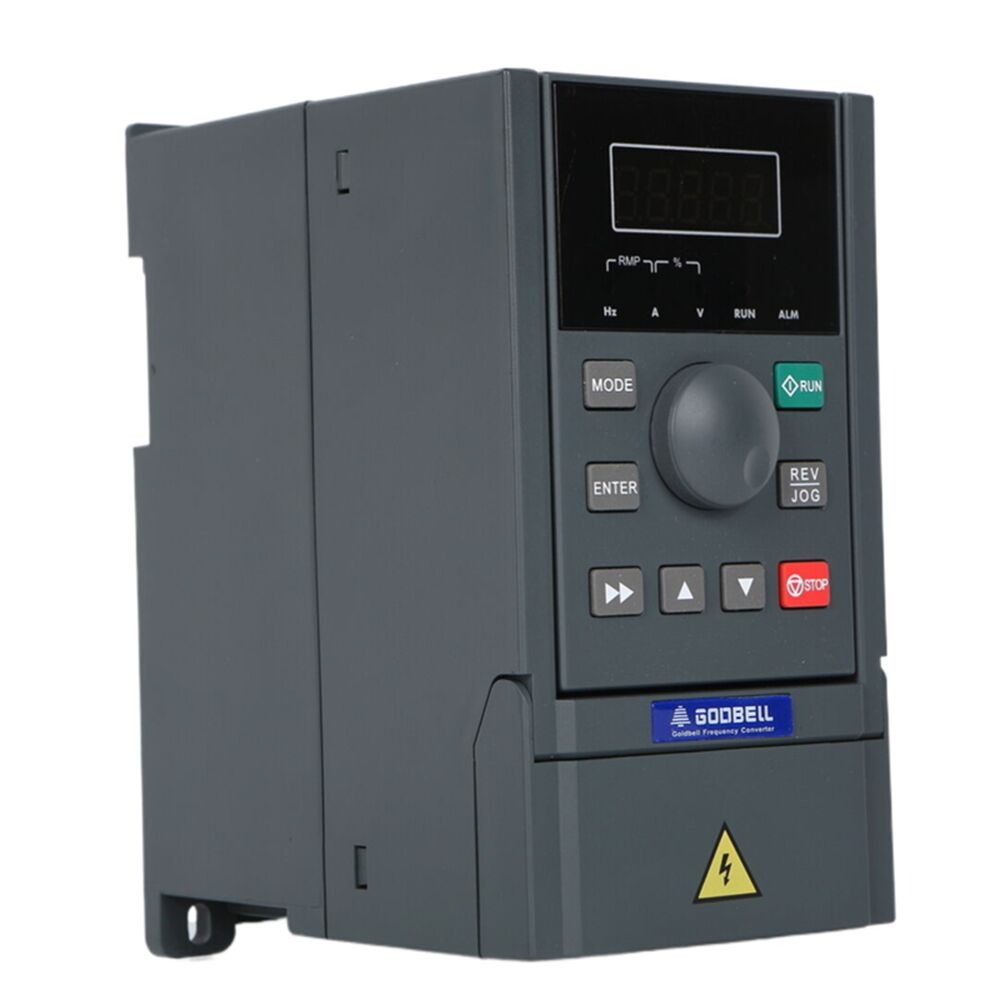
VFD Power Stage Design and Inherent Efficiency Losses
Rectifier, DC Bus, and Inverter Stage Loss Mechanisms
VFD power conversion occurs in three sequential stages—rectifier, DC bus, and inverter—each contributing distinct losses. The rectifier stage converts AC input to DC using diodes or active switches, incurring conduction and switching losses totaling 1–2% of rated power. The DC bus introduces resistive and capacitive losses (0.5–1.5%) from bus resistance and capacitor charging/discharging cycles. The inverter stage—typically built with IGBTs—accounts for the largest share of drive losses: 40–60% of total losses, per IEEE Transactions on Industry Applications (2023). These losses peak during high-frequency PWM operation, where both conduction and switching losses escalate. Thermal management is critical here; semiconductor junction temperatures above 150°C can double switching losses, accelerating degradation and reducing efficiency.
Thermal Behavior and Parasitic Losses at Partial Load
Below 60% load, fixed losses dominate VFD efficiency behavior. Control circuitry consumes 15–40 W regardless of output, making it proportionally significant at low loads. Simultaneously, reduced airflow from lower-speed cooling fans diminishes heat dissipation, raising component temperatures and conduction resistance. This thermal derating shifts loss distribution:
| Load Condition | Switching Loss Dominance | Fixed Loss Impact | Cooling Efficiency |
|---|---|---|---|
| 100% Load | 55–60% of total losses | <5% | Optimal |
| 30% Load | 30–35% of total losses | 25–40% | Reduced by ~50% |
To maintain reliability under sustained low-load conditions, drives are often oversized—a trade-off that increases capital cost and idle losses. Some modern VFDs mitigate this via adaptive switching frequency reduction during acceleration and light-load operation, though this introduces minor torque ripple and requires careful tuning.
Motor Compatibility and Load-Driven VFD Efficiency
Torque-Speed Matching Under V/f and Vector Control
VFD efficiency hinges on aligning control strategy with motor-load dynamics. V/f control maintains a fixed voltage-to-frequency ratio, delivering adequate performance for variable-torque loads like centrifugal pumps and fans—but suffers from poor low-speed torque accuracy, increasing slip losses and inefficiency in constant-torque applications such as conveyors or mixers. Vector control overcomes this by independently regulating flux and torque currents, enabling ±0.2% speed regulation even at 1 Hz. In heavy-duty industrial use, this precision reduces motor slip losses by 12–18%, per IEEE Industry Applications Magazine (2023). Misapplying V/f control to constant-torque loads—or vice versa—can increase energy waste by up to 25%. For optimal system efficiency, reserve V/f control for centrifugal, variable-torque loads and deploy vector control where high starting torque, dynamic response, or low-speed stability are required.
Motor-Specific Factors: Insulation Class, Cooling, and Bearing Currents
Standard induction motors not designed for VFD duty suffer accelerated aging and efficiency loss when paired with PWM-driven outputs. Harmonic-rich waveforms cause additional stator and rotor heating—raising winding temperatures by 15–25°C—and degrading insulation integrity while increasing copper and core losses by 3–5%. VFD-optimized motors address these issues with three key enhancements:
| Feature | Efficiency Impact | Standard Motor Limitation |
|---|---|---|
| Insulation (Class F/H) | Withstands steep 1500 V/μs PWM dv/dt spikes | Class B insulation fails at ~600 V/μs |
| Enhanced cooling | Maintains full torque rating down to 10% speed | Overheats significantly below 30% speed |
| Bearing protection | Blocks shaft voltages that cause EDM pitting | Unprotected bearings fail up to 3× faster |
When correctly matched, VFD-optimized motors sustain efficiency within 1–2% of sinusoidal supply performance—versus 3–5% degradation in standard units. Adding harmonic filters further reduces core losses by 18% in VFD-motor systems, according to the EPRI Power Quality Study (2024).
System-Level VFD Efficiency: Pump and Fan Application Dynamics
Operating Point Shift Relative to Best Efficiency Point (BEP)
Traditional pump and fan systems frequently operate motors at fixed speed, relying on mechanical throttling (e.g., valves, dampers) to regulate flow or pressure. This forces operation far from the motor-pump system’s Best Efficiency Point (BEP), resulting in hydraulic inefficiencies, excess heat generation, vibration, and wasted energy. VFDs eliminate this mismatch by adjusting motor speed directly to match real-time demand—whether maintaining chilled water flow in HVAC or pressure in municipal water networks. By keeping the motor operating near its BEP across varying loads, VFDs reduce electrical input power by 20–60% compared to throttled alternatives. Unlike mechanical restriction—which dissipates energy as heat and stress—the electronic speed control minimizes parasitic losses throughout the entire drive-train.
Affinity Law Implications for Flow, Pressure, and Power Savings
Centrifugal pump and fan performance follows the affinity laws, which define the cubic relationship between speed and power:
- Flow rate ∝ Speed (N)
- Pressure ∝ Speed² (N²)
- Power ∝ Speed³ (N³)
This nonlinearity enables exponential energy savings: a 20% speed reduction cuts power consumption to just 51.2% of baseline—nearly halving energy use. Field data from industrial retrofits confirm consistent 30–40% energy reductions in chilled water pumping systems after VFD integration. Because VFDs avoid constant-speed “over-capacity” operation during partial-load periods, they sustain high motor efficiency across the full operating range—reducing both energy costs and mechanical wear on motors, couplings, and driven equipment.
Installation, Power Quality, and Environmental Factors Impacting VFD Long-Term Efficiency
Installation quality and environmental conditions determine whether a VFD delivers its rated efficiency over time. Drives must be installed in clean, well-ventilated enclosures to prevent overheating—elevated temperatures degrade semiconductors and electrolytic capacitors, raising conduction losses and shortening service life. Every 10°C above rated ambient temperature can halve capacitor lifespan. Shielded motor cables and low-impedance grounding are essential to suppress electromagnetic interference (EMI), which may corrupt feedback signals and force unnecessary corrective action—degrading control accuracy and efficiency. Power quality also plays a decisive role: voltage sags, transients, and harmonic distortion increase stress on the rectifier and DC bus, elevating losses and accelerating component fatigue. High humidity, dust ingress, and operation at altitude (>1,000 m) further necessitate derating or supplemental cooling. Proactive maintenance—including periodic inspection of cooling fans, air filters, and terminal connections—preserves initial efficiency gains. Without disciplined attention to installation, power conditioning, and environment, even top-tier VFDs will underperform and fail prematurely.
FAQ
What are the main stages of a VFD power conversion system?
The main stages include the rectifier stage, the DC bus stage, and the inverter stage. Each stage introduces distinct losses, with the inverter stage contributing the largest share of total losses.
How do partial-load conditions affect VFD efficiency?
At low loads, fixed losses become more significant, and reduced airflow from slower cooling fans raises component temperatures, affecting efficiency. Some drives address this with adaptive switching frequencies.
Why is motor compatibility crucial for VFD efficiency?
Using VFD-optimized motors prevents accelerated aging and efficiency loss caused by harmonic-rich waveforms. These motors feature enhancements like better insulation, cooling, and bearing protection.
How do affinity laws impact energy savings in pump and fan applications?
Affinity laws show that small speed reductions result in exponential power savings (e.g., a 20% speed reduction halves energy consumption), making VFDs highly efficient in these applications.
What factors affect the long-term efficiency of VFDs?
Key factors include proper installation, power quality, and environmental conditions. Overheating, poor grounding, dust, and high humidity can degrade VFD performance and lifespan.