 ×
×
Most installers think they can just take a standard industrial VFD, wire it to a solar string, and call it a day. That is the fastest way to blow a capacitor or burn out a submersible motor. Solar energy isn't like the grid. It doesn't sit still. It fluctuates with every passing cloud, every degree of temperature change, and every minute the sun moves across the sky.
If you are spec'ing a system for a remote farm or a community water project, you aren't just buying a motor controller. You are buying a power management system. This guide breaks down the technical grit of selecting the right Variable Frequency Drive (VFD) for solar water pumping without the marketing fluff.
Why a Standard Industrial VFD Fails on Solar
Grid-tied VFDs are designed for a stable AC input. They expect a 380V or 460V supply with maybe a 10% fluctuation. In a solar setup, you are feeding DC directly into the DC bus of the drive.
Here is where it gets messy.
A standard industrial VFD usually has an over-voltage trip around 800VDC for a 400V class drive. If your solar array’s open-circuit voltage (Voc) hits that on a cold, bright morning, the drive trips immediately. Conversely, if a cloud passes, the DC bus voltage drops. A standard drive doesn’t know what to do when the voltage dips to 400VDC while under load; it tries to maintain the output frequency, the current spikes, and the drive hits an under-voltage fault or an over-current trip.
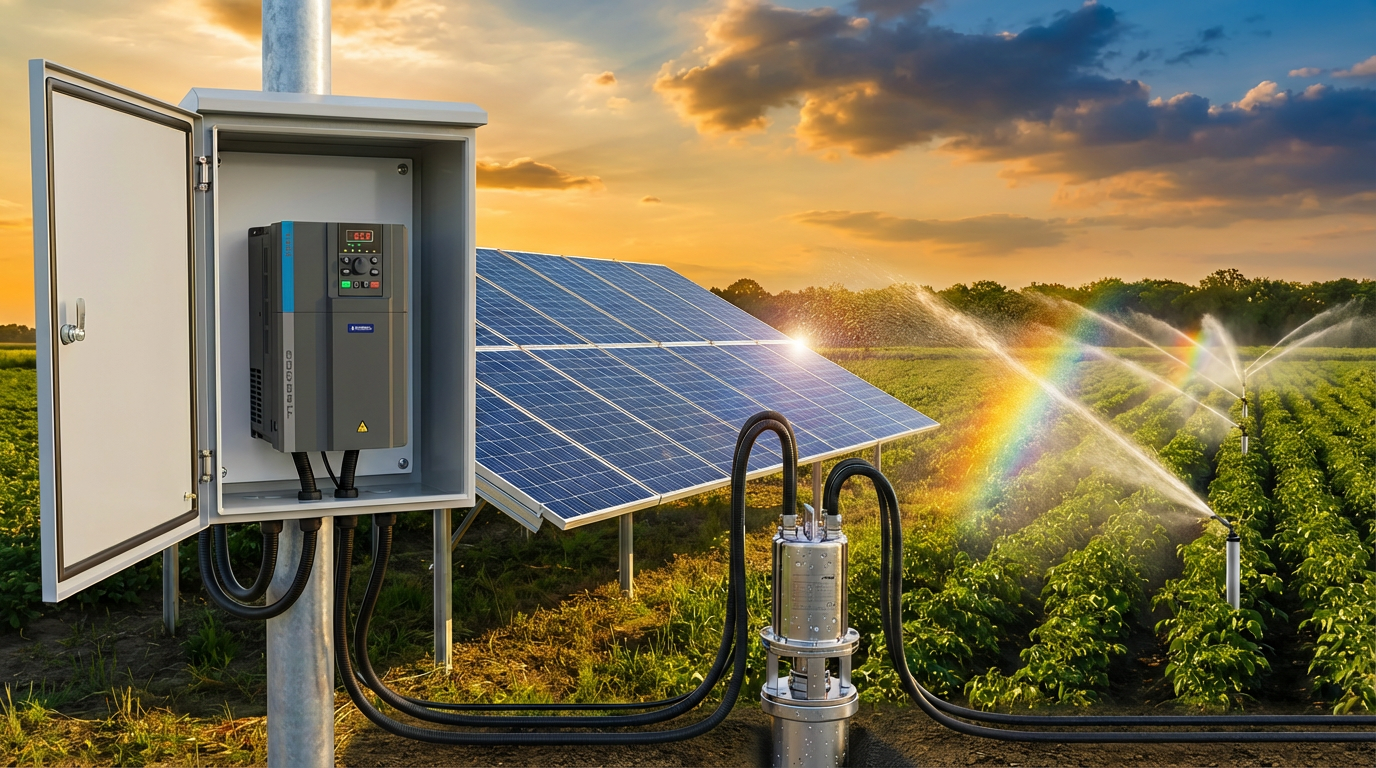
You need a drive that is built for DC bus fluctuations. A dedicated solar pump inverter, like the [INTERNAL LINK: Goldbell G580MPV → /products/g580mpv-solar-pump-inverter], is designed to track that moving target. It uses the DC bus voltage as its primary logic input, adjusting the motor speed in real-time to match the available power.
Field Note: The "Cold Morning" Trap
Installers often calculate solar string voltage based on standard test conditions (25°C). In the field, early morning temperatures might be 5°C. Solar panels have a negative temperature coefficient—voltage goes up when it’s cold. If you size your string too close to the VFD’s maximum DC input, that first frosty morning will fry the input stage of your drive before the sun is even fully up. Always leave a 15% safety margin on your Voc calculations.
The 3 Critical Specs to Match
Before you look at a datasheet, you need three numbers from the site. If you guess these, the system will either underperform or fail within six months.
1. Motor Rated Power (and Current)
Don't just look at the horsepower (HP) or kilowatts (kW). Look at the Full Load Amps (FLA). Submersible motors, especially older ones or high-efficiency models, can have higher current draws than standard surface motors. Your VFD must be sized based on the output current, not just the kW rating. If the motor pulls 18A at full load, don’t buy a 17A rated drive.
2. Total Dynamic Head (TDH)
The VFD doesn't just need to spin the pump; it needs to overcome gravity and friction. If your pump is at 60 meters depth and your tank is another 10 meters up, that’s 70 meters of static head. Add in pipe friction, and your TDH might be 80 meters. The VFD needs enough "oomph" to get the pump up to its minimum operating frequency (usually 30-35Hz for submersibles) just to get water to the surface.
3. Daily Water Volume Target
Solar is a game of averages. You don’t get 24 hours of pumping. You get a bell curve of power. If the client needs 50 cubic meters of water a day, you have to size the pump and the VFD to move that volume during the 5 to 6 "peak" sun hours available.
MPPT vs. Non-MPPT: The Real Efficiency Difference
Maximum Power Point Tracking (MPPT) is the brain of a solar VFD. It continuously calculates the point on the IV curve where the solar panels produce the most power.
Let’s look at a calculation example.
Imagine a 5.5kW submersible pump running on a 7.5kW solar array.
Without MPPT: The drive runs at a fixed ratio. If the voltage drops by 20% due to heat, the drive loses sync with the panels. It might only extract 4kW of the available 6kW.
With MPPT: The drive detects the voltage drop and adjusts the load (motor speed) to stay at the sweet spot.
The Math:
In a typical 6-hour peak sun day, an MPPT-enabled drive like the Goldbell G series can deliver up to 30% more water than a basic DC-to-AC converter. For a 5kW motor, that’s the difference between 150m³ and 195m³ per day. Over a year, that is 16,425,000 liters of "free" extra water just because of the software algorithm.
[INTERNAL LINK: View Goldbell VFD G series technical specs → /products/vfd-g-series]
Sizing Walkthrough: The Kenya Farm Scenario
Let's get practical. You have a farmer in Nakuru, Kenya.
The Pump: 7.5kW (10HP) submersible.
The Depth: 60 meters.
The Target: 60,000 liters per day.
Step 1: Inverter Sizing
For a 7.5kW motor, you want a VFD that can handle the heavy startup torque of a water column. I recommend "over-sizing" the inverter by one step if the ambient temperature is high. In Kenya's heat, go with an 11kW VFD. This gives you more thermal headroom.
Step 2: Solar Array Sizing
You cannot run a 7.5kW motor on a 7.5kW solar array. Efficiency losses in the motor (85%) and the VFD (97%), plus dust on panels and wiring resistance, mean you need more "fuel."
Rule of thumb: Array Power = Motor Power x 1.4.
7.5kW x 1.4 = 10.5kW of solar panels.
Step 3: String Configuration
If you use 550W panels with a Vmp (Voltage at Maximum Power) of 42V, how many do you put in series?
For a 380V AC motor, the VFD needs a DC bus voltage of around 540V to 600V to operate efficiently.
14 panels in series = 14 x 42V = 588V.
This is perfect.
Protection Features That Matter
In remote sites, there is no technician. If the VFD isn't smart, it's a brick.
1. Dry Run Protection: This is non-negotiable. If the borehole runs dry, the pump will burn its bearings in minutes. A good solar VFD monitors the output current. If the current drops while the frequency is high, the drive knows the pump is "spinning in air" and shuts down.
2. Low-Solar Restart: You don't want to drive out to the farm to reset the VFD every time a cloud passes. The drive should hibernate when power is low and automatically wake up when the DC bus hits the "start" threshold.
3. Over-voltage/Lightning Protection: Solar arrays are giant antennas for lightning. Ensure your VFD has built-in surge protection and that you use an external DC SPD (Surge Protective Device).
Pro Tip: The "Well Refresh" Timer
When a dry-run fault occurs, don't set the VFD to restart immediately. Most boreholes take time to recharge. Set a 30-minute "well refresh" delay in the VFD parameters. This prevents the pump from "cycling"—turning on and off every 30 seconds—which is the number one cause of motor winding failure.
Common Wiring Mistakes
The DC Disconnect: I see too many people using AC breakers for DC solar strings. AC breakers are not designed to quench a DC arc. If you try to flip an AC breaker under a 600VDC load, it might weld itself shut or explode. Use a rated DC isolator.
Earthing (Grounding): Submersible motors are sitting in water. If your VFD isn't properly earthed to the motor frame and the solar mounting structure, you are creating a massive safety hazard. In many off-grid sites, the "soil" is actually dry sand. You might need a chemical grounding rod to get the resistance low enough.
Cable Length: The run from the VFD to the borehole might be 100 meters. This creates high-frequency voltage spikes (dv/dt) that can pinhole the motor insulation. If your cable is longer than 50 meters, install an output reactor between the VFD and the motor.
The Goldbell G580MPV Advantage
When we designed the [INTERNAL LINK: G580MPV Solar Inverter → /products/g580mpv-solar-pump-inverter], we focused on the stuff that actually breaks in the field. It handles wide DC input ranges, has a dedicated MPPT algorithm that doesn't "hunt" in cloudy weather, and includes a built-in boost circuit option for smaller arrays.
It’s not about having the flashiest screen; it’s about the drive staying alive when the ambient temperature hits 45°C and the input voltage is dancing all over the place.
FAQ: Real Questions from the Field
Q: Can I run my solar pump VFD on a generator at night?
A: Most dedicated solar inverters like the G580MPV have dual-mode inputs. You can wire the solar to the DC terminals and a generator/grid to the AC terminals. Some even support automatic switching—when the sun goes down, the generator kicks in.
Q: Do I need batteries?
A: No. In 95% of irrigation cases, it is cheaper to store water in a tank than to store electricity in batteries. Use the VFD to pump whenever the sun is out.
Q: Why is my pump only vibrating and not moving water?
A: You likely aren't hitting the "breakaway" frequency. Solar power might be enough to spin the motor slowly, but not enough to lift the water column. You need to adjust your MPPT start frequency to ensure the pump only starts when there is enough current to actually move water.
Q: Can I use a single-phase motor with a solar VFD?
A: It’s possible but inefficient. Single-phase motors use capacitors that don't play well with the modified sine wave output of a VFD. If you are building a new system, always go with a three-phase motor.
Q: How long do these drives last?
A: If sized correctly and kept out of direct sunlight, a quality VFD should last 7-10 years. The capacitors are usually the first thing to go. Keeping the drive cool is the best way to extend its life.
We focus on the R&D and production of VFDs, PV solar pump inverters, vector control drives, servo drives, and related accessories.
Building 13A, Wanyang Zhongchuang City, Daze Park, Shenjiang Industrial Park, Xinhui District,Jiangmen City,Guangdong Provice
Copyright © 2025 by Goldbell Electric Drives and Controls (Shenzhen) Co., Ltd | Privacy Policy

 EN
EN