 ×
×
I have spent many hours in hot electrical rooms explaining the same thing to factory owners: a soft starter is not a "budget VFD." If you buy a soft starter to save energy on a centrifugal pump, you are throwing money into a furnace.
If you just need to stop your conveyor belt from jerking and snapping at startup, a VFD is overkill. You're buying a Ferrari to go to the grocery store.
Choosing between a Variable Frequency Drive (VFD) and a Soft Starter comes down to two things: do you need to change the speed while the motor is running, or do you just need to protect the mechanical system during the first 10 seconds of startup?
The Fundamental Difference: The Dimmer vs. The Valve to understand the difference, let’s use a simple analogy.
A Soft Starter is like a slowrelease faucet. When you turn it on, it gradually increases the water pressure until the pipe is full. Once it’s wide open, the water flows at one speed. You can’t slow it down. It’s either "getting to full" or "at full." Technically, it manages the voltage to limit the "inrush current" that can be 6 to 8 times the motor’s rated current.
A VFD is like a dimmer switch on a highend LED lamp. You can turn it on slowly, but more importantly, you can keep it at 30% brightness, 50%, or 80% all day long. It doesn't just manage voltage; it manages the frequency (Hz) of the power. Since speed is proportional to frequency, you now have a throttle for your motor.
Field Note: The Harmonic Headache
Soft starters produce almost zero harmonic distortion once they reach full speed because they usually "bypass" the internal electronics using a contactor. VFDs, however, generate harmonics 24/7. If you have sensitive electronics or medical equipment nearby, a VFD might require expensive filters. Don't ignore harmonics until your PLC starts glitching.
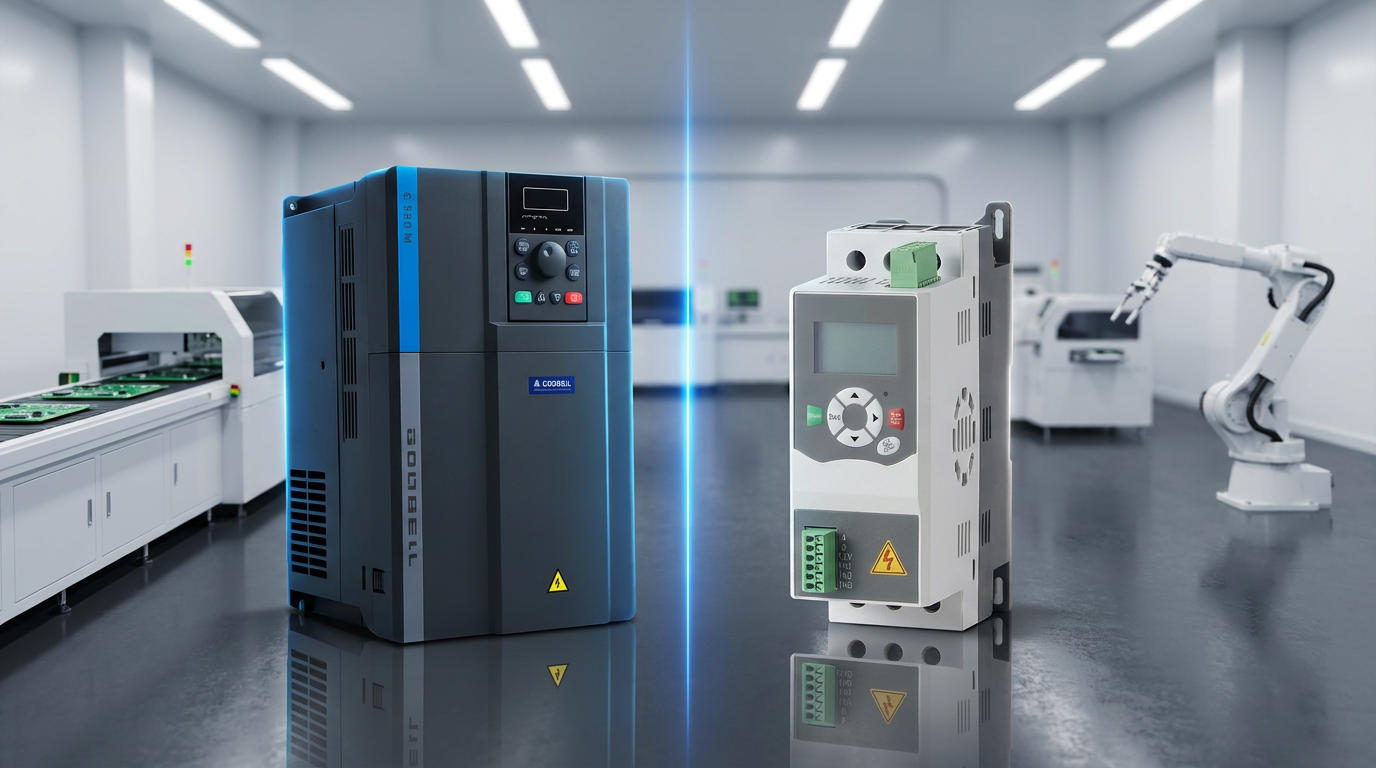
SidebySide Spec Comparison
| Feature | Soft Starter | Variable Frequency Drive (VFD)
| Primary Goal | Reduce startup current/torque | Full speed and torque control |
| Startup Current | 34x Rated Current | 11.5x Rated Current |
| Speed Control | None (Fixed 50/60Hz) | Continuous (0Hz to 120Hz+) |
| Energy Savings | Zero (at full speed) | High (on variable loads) |
| Size/Footprint | Small | Large |
| Initial Cost | Low ($) | High ($$$) |
| Mechanical Wear | Reduced (at startup only) | Significantly Reduced (constant) |
3 Scenarios Where the Soft Starter Wins
Don't let a salesman talk you into a VFD if you have one of these applications:
1. FixedSpeed Conveyors
If your conveyor belt needs to move at exactly 1 meter per second all day, every day, a soft starter is the tool. It prevents the belt from snapping or the product from falling over when you hit "Start." Once it's running, the motor is at its most efficient point.
2. Simple HVAC Ventilation
In many buildings, the fan is either on or off. If you don't have a sophisticated BMS (Building Management System) that requires variable air volume, a soft starter reduces the stress on the fan belts and the motor windings without the cost of a VFD.
3. CostSensitive Infrastructure
On a remote pumping station where the only goal is to fill a tank twice a day at max flow, a soft starter is cheaper to buy and simpler to maintain. There are fewer parameters to program and fewer points of failure.
[INTERNAL LINK: When to choose a Goldbell Soft Starter → /products/softstarters]
4 Scenarios Where the VFD Wins
1. Variable Load Applications
If you have a pump that feeds a system with varying demand (like a hotel's water supply), a VFD is the only choice. It slows down when demand is low and speeds up when it's high.
2. Massive Energy Savings
Because of the "Affinity Laws," slowing a pump down by just 20% can reduce the energy consumption by almost 50%. You can't do that with a soft starter.
3. Solar Water Pumping
Solar panels don't provide a constant "full speed" stream of power. You need a device that can track the sun and adjust the motor speed accordingly. This is where products like the [INTERNAL LINK: Goldbell G580MPV → /products/g580mpvsolarpumpinverter] dominate.
4. Precise Process Control
If you are running a printing press or a textile machine where tension must be exact, the millisecondlevel frequency control of a [INTERNAL LINK: Goldbell VFD G series → /products/vfdgseries] is mandatory.
Real Energy Savings Calculation: The 15kW Pump
Let’s look at the numbers. They don't lie.
Imagine a 15kW centrifugal pump running 8 hours a day, 300 days a year.
Electricity cost: $0.15/kWh.
With a Soft Starter: The pump runs at 100% speed.
15kW x 8h x 300 days = 36,000 kWh per year.
Cost: $5,400 per year.
With a VFD (running at 80% speed for the same flow requirement):
Power is proportional to the cube of the speed.
(0.8)^3 = 0.512.
The pump now only uses 51.2% of its rated power.
15kW x 0.512 = 7.68kW.
7.68kW x 8h x 300 days = 18,432 kWh per year.
Cost: $2,764.80 per year.
The result: You save $2,635.20 every year. The VFD pays for itself in less than 12 months.
Total Cost of Ownership (5Year View)
Most purchasing managers look at the "Buy Price." Most maintenance managers look at the "Life Price."
1. Purchase Price: Soft starter is ~40% the price of a VFD.
2. Installation: Soft starter is easier. VFD needs shielded cable and maybe a reactor.
3. Maintenance: Soft starters are rugged. VFDs have fans and capacitors that need checking every 35 years.
4. Energy: VFD wins by a landslide in 80% of applications.
Over 5 years, the energy savings of a VFD on a variable load will usually dwarf the initial savings of a soft starter by 10 to 1.
The Hybrid Mistake: The "Energy Saving" Soft Starter
I see this on RFP documents all the time: "Please quote a soft starter for energy savings."
Let me be clear: A soft starter does not save energy.
In fact, it might actually use slightly more energy than a directonline starter during the rampup phase because of heat loss in the SCRs (Silicon Controlled Rectifiers). Once it hits full speed and the bypass contactor closes, it uses exactly what the motor needs—nothing more, nothing less. If you need to save electricity, you need to change the speed. If you need to change the speed, you need a VFD.
Pro Tip: The "Water Hammer" Killer
If you are dealing with vertical pipes in a highrise or deep well, shutting a pump off instantly causes "water hammer"—a shockwave that can burst pipes. Both VFDs and soft starters can "soft stop," which gradually slows the motor down to 0Hz, preventing the check valve from slamming shut. This alone can save thousands in plumbing repairs.
Decision Flowchart (TextBased)
Q1: Does your motor need to run at different speeds during the day?
Yes → Buy a VFD.
No → Go to Q2.
Q2: Is the startup current tripping your breakers or causing lights to flicker?
Yes → Go to Q3.
No → A simple contactor (DOL) might work, but a Soft Starter is safer for the mechanicals.
Q3: Is energy cost a major concern and can you tolerate a lower flow rate?
Yes → Buy a VFD.
No → Buy a Soft Starter.
Q4: Are you using solar panels as the power source?
Yes → Buy a Solar VFD (G580MPV).
No → Go with industrial AC units.
FAQ: Questions I Hear in the Field
Q: Can I use a VFD to run a 60Hz motor on 50Hz power?
A: Yes. A VFD can take 50Hz input and output 60Hz (or any other frequency). A soft starter cannot do this.
Q: Which one is better for "Heavy Start" loads like a rock crusher?
A: A VFD is superior. A soft starter might struggle to provide enough torque to "break" the load loose without drawing massive current. A VFD can provide 150% torque at 1Hz, allowing it to start heavy loads smoothly.
Q: Do VFDs burn out motors?
A: If the cable is very long (>50m), the highfrequency switching of the VFD can cause "reflective waves" that damage insulation. Using a motor with "inverterduty" insulation or adding an output filter to your Goldbell VFD solves this.
Q: Is a VFD harder to program?
A: It has more parameters (acceleration, deceleration, minimum frequency, etc.), but for basic use, you only need to enter the motor's nameplate data. The Goldbell VFD G series has an autotune feature that does most of the heavy lifting for you.
We focus on the R&D and production of VFDs, PV solar pump inverters, vector control drives, servo drives, and related accessories.
Building 13A, Wanyang Zhongchuang City, Daze Park, Shenjiang Industrial Park, Xinhui District,Jiangmen City,Guangdong Provice
Copyright © 2025 by Goldbell Electric Drives and Controls (Shenzhen) Co., Ltd | Privacy Policy

 EN
EN