
 EN
EN



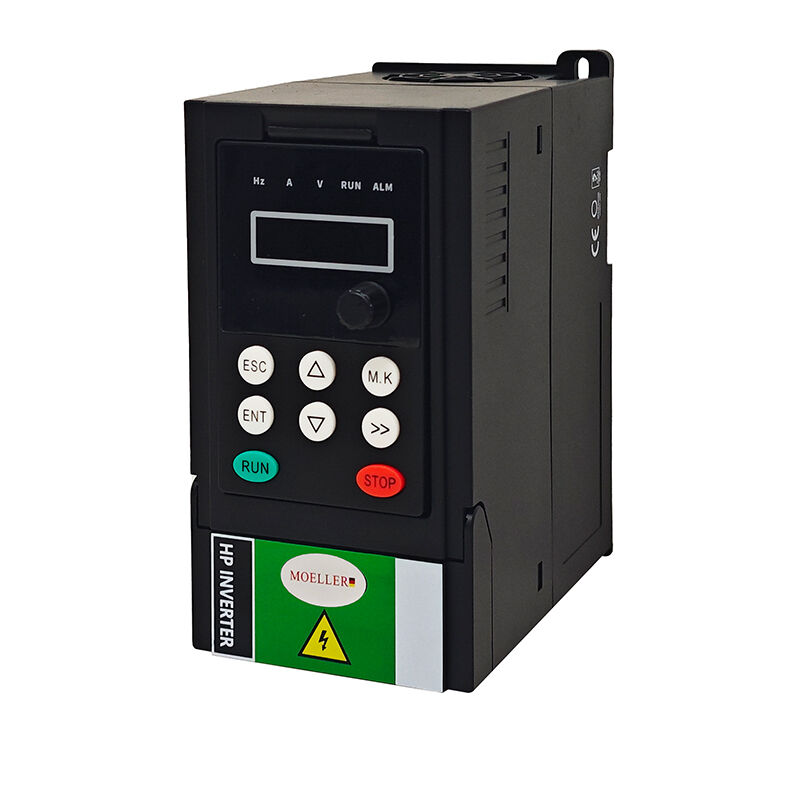
Why Motor Power and Frequency Converter Capacity Must Be Precisely Aligned
Matching motor power with frequency converter capacity prevents operational failures and energy waste. Undersized converters trigger frequent overcurrent trips during motor startup—when peak current demands exceed the drive’s temporary overload rating—while oversized units waste capital and compromise low-speed torque control. Industry reliability reports indicate that power rating mismatches increase harmonic distortion by ~40%, accelerating motor insulation degradation. Efficiency drops significantly when converters operate outside their validated torque-speed envelope.
Proper alignment begins with calculating starting demands: inertia-heavy loads like compressors require converters with up to 150% temporary overload capacity, whereas constant-torque applications may only need 110%. Voltage mismatch compounds risk—pairing a 480V motor with a 230V converter induces magnetic saturation and core losses exceeding $740k annually in mid-sized plants (Ponemon 2023). Modern self-regulating systems mitigate these issues through integrated motor identification sequencing, which validates compatibility before commissioning. Thermal monitoring algorithms then dynamically adjust switching frequencies during load transients to preserve stability.
The most robust frequency converters feature wide voltage tolerance bands that accommodate grid fluctuations without sacrificing sine wave purity. Adaptive vector control—not generic V/f curves—maps exact motor characteristics via auto-tuning protocols. Verified power band matching eliminates stalling in conveyors during sudden load changes and prevents water hammer in pumped systems. System-level tuning maintains rotor flux orientation within ±2% despite harmonics—a requirement for elevator positional accuracy and other precision motion applications.
Data-driven selection protocols have reduced motor-converter mismatch incidents by 68% industry-wide since 2020, according to electrical safety boards. This precision extends component lifecycles beyond rated MTBF while lowering total ownership costs more effectively than standalone energy-saving programs. Each 10% deviation from ideal sizing cuts drive efficiency by approximately 3.7 percentage points at partial loads, as confirmed in 4-year durability trials. These losses compound rapidly in continuous operation—making thorough machine evaluation prior to integration essential.
How Motor Characteristics and Control Mode Affect Frequency Converter Stability
Induction motors exhibit inherent torque-speed structuring under variable-frequency operation. Maintaining flux stability becomes increasingly difficult below base frequency due to V/f scaling limitations. At very low stator frequencies—typically under 3 Hz—systems risk native instability, requiring active control augmentation to manage slip-torsional dynamics. Torque production deteriorates disproportionately as linear voltage reduction weakens the magnetic field (Piotonko 2019).
Torque-speed behavior of induction motors under variable-frequency operation
Below base frequency (e.g., <50 Hz in utility grids), inadequate voltage proportioning causes torque curves to slump at reduced speeds. As frequency declines, insufficient excitation voltage increases slip relative to stator excitation, impairing torque delivery. Motors may stall during loaded startups—even with precise frequency modulation—unless voltage is actively compensated. This physical reality underscores why flux stability demands meticulous, application-specific voltage-frequency coordination.
| Torque Degradation Threshold | Control Countermeasure |
|---|---|
| Below 10% rated frequency | Boost V/f profile 120% |
| Sub-3Hz operation | Vector compensation modes |
| High-slip regions (≥4%) | Slip compensation algorithms |
Scalar (V/f) vs. vector control: Implications for stable frequency converter performance
Scalar V/f control remains suitable for centrifugal loads like fans and pumps, where torque fidelity is secondary to flow regulation. Its linear voltage-tracking approach delivers acceptable stability within ±½ slip above 2 Hz—but collapses near standstill. In contrast, vector control decouples stator current into orthogonal flux and torque components using coordinate transforms. This enables sub-1Hz stable operation with millisecond-level response times—far surpassing V/f’s inherent instability under critical torque loads (Schmidt 2016). For applications demanding rapid acceleration, precise positioning, or high dynamic torque—such as elevators or packaging machinery—vector control is non-negotiable.
Real-World Validation: Correct Frequency Converter–Motor Pairing in Practice
Success case: 15 kW pump motor paired with 18.5 kW frequency converter
A water treatment facility replaced an aging fixed-speed pump with a 15 kW induction motor controlled by an 18.5 kW frequency converter. The 23% capacity headroom enabled reliable handling of locked-rotor current during startup and maintained voltage stability across load variations. Over 24 months, operators recorded a 12% reduction in energy consumption and zero nuisance trips. Crucially, the converter’s continuous current rating exceeded the motor’s full-load current by more than 10%, satisfying the manufacturer’s minimum margin requirement.
Failure analysis: Thermal overload from mismatched V/f profile and motor insulation class
A packaging line experienced repeated thermal shutdowns of a 7.5 kW motor paired with a frequency converter. Investigation revealed the drive applied a fixed V/f ratio down to 5 Hz—causing excessive current draw and inadequate cooling airflow across the motor’s Class-B insulation (130 °C max). Prolonged low-frequency operation pushed winding temperatures beyond design limits, triggering premature failure. Resolution required reprogramming the converter with enhanced low-speed torque boost and verifying that the motor’s insulation class supported the revised duty cycle.
Step-by-Step Selection Checklist for Reliable Frequency Converter Integration
A methodical checklist prevents misalignment between motor power and frequency converter capacity:
- Record motor nameplate data: Full-load current (FLA), voltage, rated speed, and insulation class—not just horsepower.
- Match continuous current ratings: Ensure the converter’s continuous output current meets or exceeds the motor’s FLA. Horsepower alone is insufficient.
- Account for overload requirements: Add temporary capacity for inertia loads—110–150% for pumps, conveyors, or compressors—based on application duty cycle.
- Apply environmental margins: Increase converter size by 10–20% for ambient temperatures above 40 °C or cable runs longer than 50 meters.
- Select appropriate control mode: Use scalar (V/f) for simple centrifugal loads; choose vector control for applications needing precise torque, fast response, or stable operation below 3 Hz.
- Verify electrical compatibility: Confirm input voltage matches supply, and protective features (overcurrent, overvoltage, thermal) align with motor specifications.
- Validate under real load: Conduct commissioning tests at minimum, nominal, and peak loads—including start-up and transient conditions—to confirm stable, trip-free operation before full deployment.
Frequently Asked Questions
Why is it essential to match motor power with frequency converter capacity?
Matching motor power with frequency converter capacity ensures operational stability, prevents energy waste, and reduces equipment wear. Mismatches can lead to issues like overcurrent trips, energy inefficiency, and accelerated motor insulation degradation.
How do starting demands affect frequency converter selection?
Starting demands depend on the load type. Inertia-heavy loads, such as compressors, require converters with up to 150% overload capacity, while constant-torque applications may only need a 110% margin.
What is the difference between scalar (V/f) control and vector control?
Scalar V/f control is suitable for simple loads like fans and pumps, while vector control provides precise torque and speed regulation, especially under critical conditions. Vector control is ideal for applications requiring high dynamic performance or low-speed operation.
How can I verify if the motor and frequency converter are compatible?
Compatibility can be verified by ensuring matching voltage levels, continuous current ratings, and overload capabilities. Real load commissioning tests further validate stable operation under different conditions.
What are common issues caused by mismatched frequency converter settings?
Common issues include thermal overload, excessive energy waste, frequent shutdowns, and premature equipment failure. These problems can be mitigated with proper configuration and load testing.
Table of Contents
- Why Motor Power and Frequency Converter Capacity Must Be Precisely Aligned
- How Motor Characteristics and Control Mode Affect Frequency Converter Stability
- Real-World Validation: Correct Frequency Converter–Motor Pairing in Practice
- Step-by-Step Selection Checklist for Reliable Frequency Converter Integration
-
Frequently Asked Questions
- Why is it essential to match motor power with frequency converter capacity?
- How do starting demands affect frequency converter selection?
- What is the difference between scalar (V/f) control and vector control?
- How can I verify if the motor and frequency converter are compatible?
- What are common issues caused by mismatched frequency converter settings?